

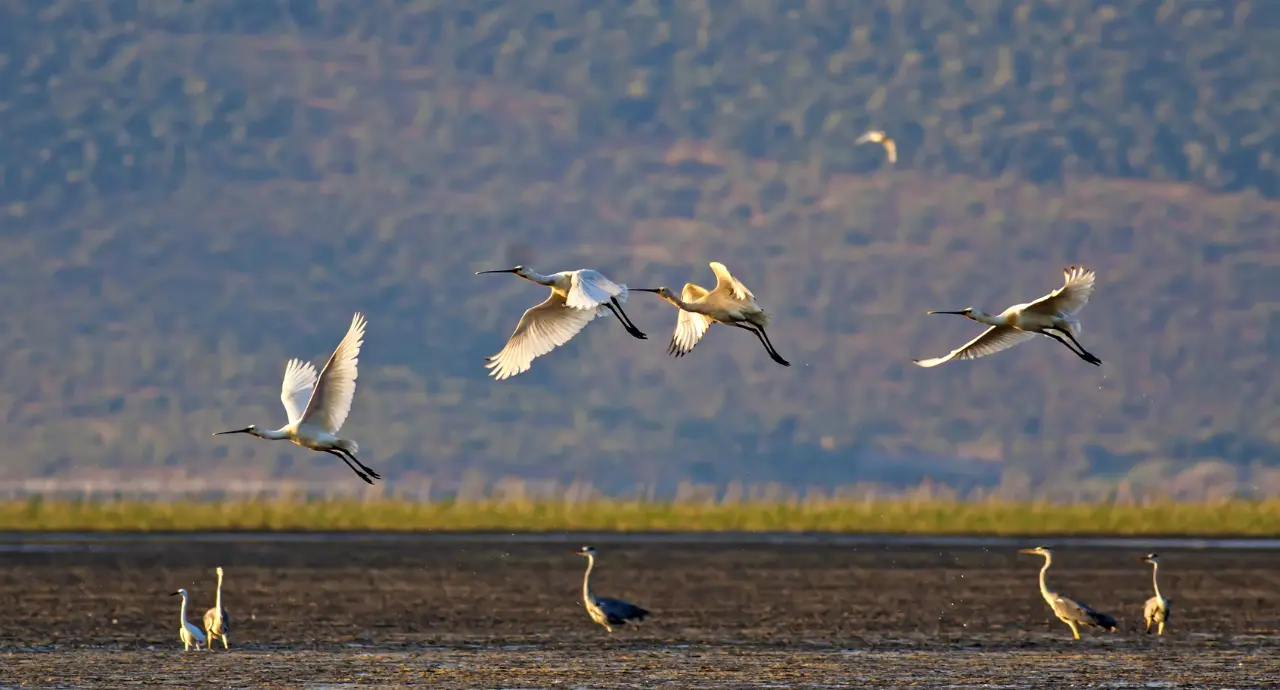
Winter Birdwatching in the Ria Formosa
Discover winter birdwatching in the Ria Formosa, Algarve, Portugal. Explore the best birdwatching spots near Tavira, Fuseta, Olhão and Faro, discover migratory birds such as flamingos, spoonbills and waders, and enjoy peaceful nature walks through the Eastern Algarve’s beautiful wetlands. Find practical tips on the best time to visit, birdwatching locations, essential equipment and wildlife-friendly travel, plus holiday homes near the Ria Formosa for a relaxing winter nature escape.
Inside this story
Winter changes the rhythm of the Ria Formosa. The summer beach crowds are gone, the lagoons feel quieter, and the salt pans, mudflats and marshes become some of the most interesting places in the Algarve to spend a morning outdoors. For birdwatchers, this is more than simply a peaceful time to visit because winter brings large numbers of migratory waterbirds to the wetlands.
Many aquatic birds from northern Europe spend the winter here or use the Ria Formosa as a stopping point while travelling farther south. The protected area includes salt marshes, tidal mudflats, lagoons, salt pans, dunes and freshwater habitats, creating feeding and resting areas for a remarkable variety of species. Portugal's nature conservation authority describes the Ria Formosa as one of the country's most important areas for migratory birds, particularly waders, ducks and other waterbirds.
You do not need to be an experienced birder to enjoy it. A pair of binoculars, comfortable shoes and enough time to stop and watch can transform an ordinary winter morning into one of the most memorable experiences of an Eastern Algarve holiday.
Why Winter Is Special for Birdwatching in the Ria Formosa
The Ria Formosa is important for birds throughout the year, but winter brings a particularly noticeable increase in waterbirds. Species arriving from northern Europe use the lagoon's salt pans, marshes and intertidal areas for shelter and food, while resident species continue to make the wetlands their home.
Official nature-tourism information for the Algarve notes that thousands of aquatic birds use the lagoon and surrounding habitats during winter, including flamingos, spoonbills and ducks. It also identifies the Ria Formosa as one of Portugal's most significant areas for wintering waders outside the Tagus estuary.
This is one reason winter birdwatching here can feel so rewarding. You are not visiting a small reserve where wildlife is concentrated around a single hide; you are exploring a living coastal landscape stretching across much of the Eastern Algarve. A walk beside the salt pans near Tavira, a morning in Fuseta and a visit to Quinta de Marim can all produce different experiences.
The quieter season also helps. Without the heat and activity of midsummer, it becomes easier to stay outside longer, watch patiently and enjoy the landscape even when a particular bird refuses to appear.
What Birds Can You See in Winter?
Flamingos are often the birds visitors hope to see first, and they certainly occur in the Ria Formosa, but they are only part of the story. Depending on the location, tide, weather and time of year, winter visitors may encounter spoonbills, herons, egrets, ducks, waders and birds of prey as well as the Ria Formosa's resident species.
The official ICNF description of the park identifies wintering ducks such as mallard, Eurasian wigeon, northern shoveler and Eurasian teal. Among the waders found in the area are grey plover, bar-tailed godwit, black-tailed godwit, Eurasian curlew, avocet and dunlin. Raptors such as peregrine falcons, common buzzards and harriers may also be seen during migration and winter.
The purple swamphen deserves special attention because it is the emblematic bird of the Ria Formosa Natural Park. Visit Portugal also highlights flamingos, spoonbills and purple swamphens among the characteristic birds visitors may encounter within the protected wetlands.
It is important, however, not to treat birdwatching like a guaranteed wildlife checklist. Flamingos may be visible from one salt pan one day and feeding somewhere completely different the next. That uncertainty is part of the experience, and spending time observing the whole wetland rather than chasing one particular species usually makes for a more enjoyable morning.
Best Places for Winter Birdwatching in the Ria Formosa
The Ria Formosa extends for roughly 60 kilometres along the Algarve coast and contains many different habitats, so there is no single "best" birdwatching point for every visitor. Portugal's nature conservation authority lists locations including Ludo, Quinta de Marim, Fuseta, the Tavira and Santa Luzia salt pans, Cacela Velha and other parts of the lagoon among recognised places for birdwatching.
For Somewhere Special guests staying in the Eastern Algarve, several of these areas are particularly convenient.
1. Quinta de Marim, Olhão
If this is your first birdwatching trip in the Ria Formosa, Quinta de Marim is an excellent place to begin because it gives you an introduction to several habitats within one manageable visit.
The Environmental Education Centre of Marim sits on a former agricultural property beside the lagoon and has a marked circular trail of approximately 2.5 kilometres. The route passes through salt marsh, dunes, woodland, shellfish nursery areas and other habitats, with two bird observatories positioned for watching aquatic species. ICNF estimates the walk takes around 1½ to 2 hours and rates it as easy.
One observatory looks towards salt-marsh habitat where waders may be seen, while the other overlooks a freshwater area used by ducks and herons. Because the route combines birdwatching with an introduction to the wider ecology of the Ria Formosa, it works particularly well for couples or families where not everyone considers themselves a serious birdwatcher.
In winter, allow yourself more time than the basic walking estimate suggests. The purpose is not to finish the circuit quickly but to stop at the observatories, scan the water carefully and let the wildlife reveal itself.
2. Tavira Salt Pans and Quatro Águas
Around Tavira, birdwatching can become part of an ordinary winter day rather than requiring a dedicated excursion. As you move away from the historic centre towards Quatro Águas and the surrounding salt pans, the urban landscape gradually opens into wetlands, shallow water and wide skies.
Salt pans are particularly interesting because shallow water provides feeding areas for many wetland species. Waders, herons and other waterbirds can often be observed in these landscapes, while changing light across the water makes this an excellent area for wildlife photography as well.
The Tavira salt pans are among the birdwatching locations specifically identified in Portugal's national birdwatching guide to the Ria Formosa. Nearby Santa Luzia and Arraial Ferreira Neto are also highlighted, demonstrating how broad the birdwatching opportunities are around this part of the lagoon.
One of the pleasures of birdwatching here is accessibility. You can spend the morning beside the salt pans and then return to Tavira for lunch without turning birdwatching into an all-day expedition.
3. Fuseta and the Salt Pans
Fuseta is especially appealing for travellers who want birdwatching to become part of the holiday rather than something they have to drive somewhere to do. The town sits directly beside the Ria Formosa, with salt pans, lagoon channels and wetlands surrounding the wider area.
Somewhere Special's own local Ria Formosa guide notes that the Eastern Algarve supports a broad diversity of birdlife and that flamingos regularly visit the salt pans around Fuseta. The company specifically positions its Loft With a View as accommodation for birdwatchers, with views across the surrounding salt-pan landscape.
That proximity changes the experience. Instead of scheduling a two-hour birdwatching excursion, you can look outside in the morning, take your binoculars and spend an hour exploring before breakfast or lunch. If the conditions are particularly good, stay longer; if the wind gets stronger, you have not committed the entire day.
Fuseta is therefore a particularly attractive base for travellers who want a slower winter holiday built around nature, walking and observing the changing Ria Formosa landscape.
4. Ludo and the Western Ria Formosa
For visitors prepared to travel towards Faro and Quinta do Lago, Ludo is another important birdwatching area. The landscape here includes salt pans, tidal channels, marshes and nearby freshwater habitats, creating opportunities to observe a broad variety of species.
The Algarve's official nature-tourism guide describes Ludo as possibly the area of the Ria Formosa with the greatest abundance of wintering aquatic birds. It notes that many of Portugal's wintering duck species may be observed in this part of the wetland.
For Somewhere Special guests based farther east, Ludo makes more sense as a dedicated birdwatching day than a casual morning walk. The benefit is variety: visiting a western Ria Formosa site after spending time around Tavira or Fuseta allows you to experience how the habitats and bird populations change across the lagoon system.
Serious birdwatchers staying for a week or longer may find that exploring several different parts of the Ria Formosa is far more rewarding than returning to the same observation point every day.
5. Cacela Velha and the Eastern End of the Ria Formosa
At the opposite end of the lagoon, Cacela Velha offers a more open view across the eastern Ria Formosa. The small village stands above the lagoon, providing a beautiful perspective over channels, sandbanks, marshes and the barrier-island landscape.
Cacela Velha is included among the recognised birdwatching locations in ICNF's national guide, but the appeal is broader than spotting individual species. This is a place where the entire wetland landscape becomes easier to understand because you can see how land, lagoon and sea connect.
Spend some time at the viewpoint before exploring lower areas nearby. Bird activity changes with water levels and conditions, so looking across the landscape first can help you identify where birds appear to be gathering.
For nature photographers, the combination of wide views, winter light and wildlife makes this one of the most attractive places in the eastern Ria Formosa to spend an unhurried morning.
When Is the Best Time of Day for Birdwatching?
Early morning is often a lovely time to begin because the landscape is quieter, the light is softer and you have most of the day ahead of you. Late afternoon can be equally beautiful, particularly around salt pans where low winter sunlight reflects across the shallow water.
However, the tide can be just as important as the clock in a tidal wetland such as the Ria Formosa. Water levels continually change which mudflats and feeding areas are exposed, meaning the birds you see and where they gather may vary considerably during the day.
Rather than relying on a rigid rule such as "always go at 8am", check both the weather and local tide information before heading out. If birdwatching is a major reason for your holiday, revisiting the same location at different stages of the tide can produce surprisingly different observations.
For photography, calm mornings can provide beautiful reflections around the salt pans. On windy days, more sheltered areas or established observatories such as those at Quinta de Marim may provide a more comfortable experience.
Do You Need a Guide?
Not necessarily. Many of the Ria Formosa's birdwatching areas can be explored independently, particularly if you simply want to enjoy the wildlife and landscape rather than identify every species you encounter.
A local birdwatching guide can become valuable if you are looking for particular species, want help understanding calls and behaviour, or have limited time. Experienced guides know how conditions, tides and seasons affect where birds are likely to be feeding or resting, which can make a significant difference to a more serious birdwatching trip.
Guided options are available in the Ria Formosa, including both walking and boat-based nature experiences. Visit Portugal lists operators offering dedicated birdwatching walks and nature boat trips within the Natural Park.
For beginners, however, there is no reason to feel that a guide is essential. Start somewhere accessible such as Quinta de Marim, take binoculars if possible and allow enough time to look properly.
What Should You Bring?
Birdwatching in the Ria Formosa does not require complicated equipment. A pair of binoculars will make the biggest difference because many birds feed at a distance across salt pans or mudflats, while a camera with a longer lens is useful if wildlife photography is part of your trip.
Comfortable walking shoes are worth bringing because paths around salt pans and wetlands can become softer after rain. During winter, carry a lightweight waterproof or windproof layer as well; conditions beside open water can feel considerably cooler than sheltered areas in town.
A bird identification app or compact field guide can make the experience more interesting, particularly if you are new to birdwatching. Rather than worrying about identifying everything immediately, concentrate first on shape, size, colour, feeding behaviour and location, then use your guide to narrow down what you have seen.
Most importantly, bring patience. Ten quiet minutes watching one section of water often reveals much more than continually walking in search of something new.
Birdwatching Without Disturbing the Birds
The Ria Formosa is not simply a beautiful landscape; it is a protected habitat used by resident, migratory and breeding wildlife. Good birdwatching therefore means enjoying the birds without changing their behaviour.
Use established paths and observation areas wherever possible, keep a sensible distance from feeding or resting birds and avoid approaching flocks simply to get a closer photograph. Dogs should be managed carefully around wetland areas, particularly where birds are feeding on the ground or using nearby shorelines.
The same applies to photography. A better photograph is not worth repeatedly forcing a bird to move, especially during winter when conserving energy can be important for migratory species.
The Environmental Education Centres associated with the protected area can provide information about appropriate routes and ways to enjoy the Ria Formosa while respecting its wildlife. Visit Portugal specifically recommends using these centres to learn about species and suitable paths before exploring the wetlands.
You Don't Have to Be a Birdwatcher to Enjoy Birdwatching Here
One of the nicest things about the Ria Formosa is how quickly it can turn someone who "isn't really into birds" into someone reaching for binoculars.
You might begin by noticing a group of flamingos in the distance, then start wondering about the smaller birds feeding beside them. A few days later, you find yourself slowing down whenever you pass a salt pan because you recognise the shape of a heron or want to see what is moving across the mud.
That is why winter birdwatching fits so naturally into a holiday in the Eastern Algarve. It does not have to be a specialist expedition or a timetable filled with species targets. It can simply mean taking your time, paying attention and allowing one of the Algarve's most distinctive landscapes to become part of your stay.
Stay Close to the Ria Formosa
If birdwatching is one of the reasons you are visiting the Eastern Algarve, where you stay can make a meaningful difference. Being close to the lagoon and salt pans means you can take advantage of a calm morning, changing tide or beautiful winter light without driving a long distance before you even begin.
Somewhere Special has holiday homes in and around the Ria Formosa, Fuseta and the Eastern Algarve, including properties where birdwatching and nature are literally part of the view. The Loft With a View in Fuseta, for example, overlooks the Ria Formosa salt pans and was specifically created with birdwatchers in mind.
For a winter nature holiday, that means birdwatching does not have to end when you return to your accommodation. Sometimes the most memorable sighting of the day may happen while you are simply sitting outside and looking across the wetlands.
Explore Somewhere Special's Ria Formosa holiday homes and stay closer to the landscapes you came to experience.